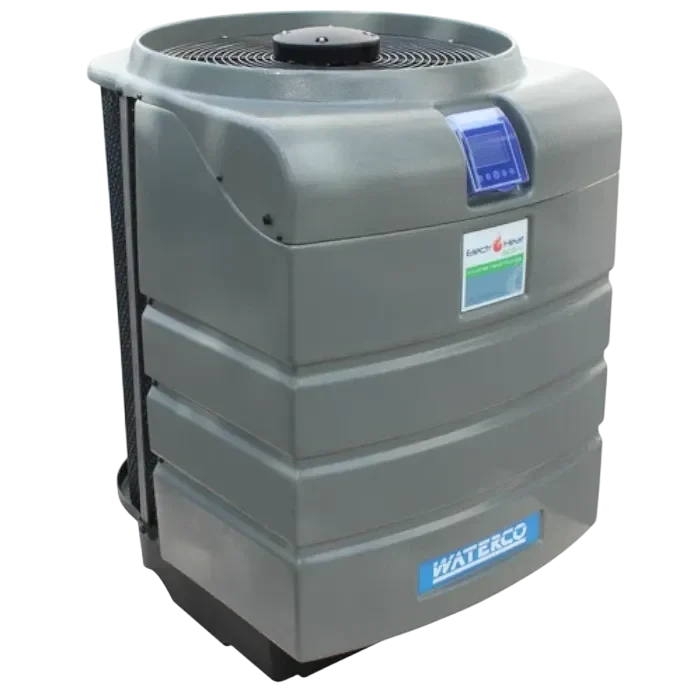
Waterco's ElectroHeat Eco-V Inverter Swimming Pool Heat Pump
Compared to gas and electric heaters, Electroheat ECO-V inverter pool heat pumps use a fraction of the energy to generate the same amount of heat and unlike solar heating; there is no reliance on the sun as the latent heat in the air is used.






Overview Waterco's ElectroHeat Eco-V Inverter Swimming Pool Heat Pump
A swimming pool is a major financial investment. Getting the most out of your pool, means keeping the pool at a swimmable temperature for the maximum number of hours each day and maximum number of days each year. A heat pump can economically keep your pool warm.
Heat pumps only require energy to operate a compressor and a fan motor, using low amperage in the process. For every 1kW of electricity consumed, Waterco ECO – V inverter heat pumps can produce up to 7kW of heat. Save up to 80% over propane gas, 50% over natural gas and 500% over electric heaters.
Compared to gas and electric heaters, Electroheat ECO-V inverter pool heat pumps use a fraction of the energy to generate the same amount of heat and unlike solar heating; there is no reliance on the sun as the latent heat in the air is used.
Energy-Efficient Inverter Technology
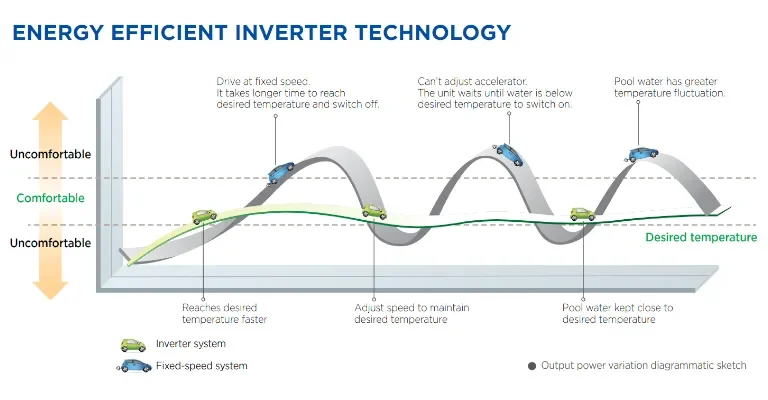
Electroheat ECO-V inverter pool heat pumps utilise a variable speed compressor to regulate the pool water temperature automatically and independently.
- Inverter technology uses a variable speed compressor motor similar to a car engine.
- It slows down and speeds up as needed to hold a selected set temperature
- The desired set temperature will be reached more quickly and maintained more efficiently.
- Inverter technology provides a more precise water temperature without the fluctuations and power.
- Wastage of fixed speed systems.
- Inverter technology is significantly more energy efficient with energy savings of between 15 – 30%.
- Over fixed speed systems.
- The speed control of the compressor and fan motor also means quieter operation.
Automatic Evaporator De-Icing
Electroheat ECO-V inverter pool heat pumps feature automatic de-icing for situations where frost or ice may develop on the evaporator as part of normal operation. Common in cooler climates or winter months, when a build-up of ice is detected the heat pump shifts temporarily into cooling mode to reverse the flow of refrigerant through the evaporator coils. Hot refrigerant moves through the outside coils, melting ice and defrosting the system. When the defrost cycle is complete, the unit shifts back to heating mode.
Features & Benefits
Smart Controls for temperature management and self diagnosis
Inbuilt Safety Devices for water flow, refrigerant level and compressor startup delay
Powerful Heat Transfer through the coiled heat exchanger, maximising water contact
Titanium Dual Coil heat exchanger is highly resistant to ozone, iodine, baquacil, salt and chlorinated water
Large Blue Fin Evaporator Area to extract more ambient heat. Blue Fin coating provides additional protection against corrosion, especially for coastal installations.
Scroll Compressor for improved efficiency and high performance
Weatherproof Cabinet for outdoor installation
R410A Refrigerant, ozone friendly and maximises performance
Automatic Hot Gas De-Icing Heats your pool even when the ambient air temperature is close to 0°
Warranty
Warranty – Residential
10 years – titanium heat exchanger
3 years – compressor
2 years – all other components
Warranty- Commercial – 1 year
*Conditions apply.
Sizes of Different Waterco ElectroHeat Eco-V Inverter Swimming Pool Heat Pumps
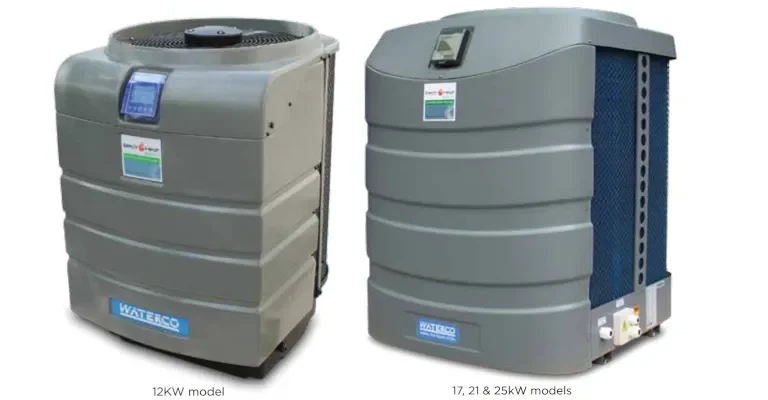
Electroheat ECO-V Inverter technology heat pumps can heat your pool in colder climates even when the ambient air temperature is close to 0°C and are ideal for heating:
Available in: 12kW heat only 17, 21, 25kW heat and cool models
The Electroheat heat pump range are an ideal solution for heating:
- Swimming pools to extend the season
- Swimming pools for year round enjoyment
- Plunge pools
- Swim spas and spas
Frequently Asked Questions
Should I use a pool cover?
The most effective way to prevent heat loss is to install a pool cover. An un-blanketed pool loses 2-3 times more heat than a blanketed pool. Pool covers virtually eliminate evaporation and reduce heat loss by insulating the surface of the pool, greatly reducing pool heating costs. As with all pool heaters, it would be advisable to use a pool cover at night, and when the pool is not in use.
What is the minimum ambient operating temperature?
The heat pump will actually operate down to an ambient air temperature of 0° if fitted with hot gas deicing but with minimal heat output. Therefore, we recommend heat pumps be operated in the warmest part of a 24 hour period to increase operating efficiency
What is the best location for the ElectroHeat?
The location of the Electroheat is very important in keeping installation costs to a minimum, while providing for maximum efficiency of operation allowing adequate service and maintenance access.
The unit should be located as close as practically possible to the existing pool pump and filter to minimise water piping. The use of 90 degree bends and short radius elbows in the water piping should be kept to a minimum. Longer distances from the pool increase piping heat loss.
Can the ElectroHeat be enclosed?
The Electroheat is designed for outdoor installation and should not be installed in totally enclosed areas such as a shed, garage, etc., unless mechanical ventilation is provided to ensure adequate air exchange for proper operation. Re-circulation of cold discharged air back into the evaporator coil will greatly reduce unit’s heating capacity and efficiency.
What is the ElectroHeat's performance dependent on?
Performance will fluctuate depending on water and weather temperatures. 5 important factors determine the performance of Electroheat:
- Size of the pool.
- The desired temperature of the pool.
- Ambient air temperature – the warmer the air, the
better the performance. - The presence of a pool cover.
- The size of the heater.
What is the ElectroHeat's heater running time?
Most units should be sized to operate during warmer months the pool filtering cycle time of 8 – 12 hours daily, providing a steady flow of heated water. On warmer days the heater will run less because the heat loss will be less.
Electroheat heat pumps have a lower heating capacity on a BTU/hr basis compared to fossil fuel based pool heaters such as gas heaters. Therefore, Electroheat heat pumps require longer operation to accomplish the desired temperature.
Between 10°C to 18°C, it will increase your water temperature by 3°C to 5.5°C a day. Over 21°C you should obtain an increase up to 0.8°C a hour and over 26°C up to 1.1°C an hour depending on the size of the pool, the size of the heat pump, the water temperature, and the ambient air temperature at the moment of operation.
Even though the Electroheat may require longer operation, it will still heat the pool far more economically.
How does ElectroHeat compare with solar heating and gas heating?
Solar
- Fuelled by the power of the sun, solar heating systems are a low-cost method of heating up your pool water
- As solar heating is reliant on the sun, they are best used to extend the swimming season.
- Virtually no operating costs, just the cost of electricity to pump the pool water through the solar absorber on the roof.
Gas heaters
- Gas heaters are the fastest method for heating your pool, providing a comfortable temperature for swimming on demand. Gas is best for heating pools or spas for short periods of time.
- Gas heaters can easily maintain any desired temperature regardless of the weather.
- Gas heaters are effective, but expensive to operate.
Heat pumps
- Heat pumps may not heat up the swimming pool as fast as gas heaters, but are more energy efficient.
- Heat pumps require a small amount of electricity; its heat energy source is extracted from the ambient air.
Performance Specifications
| Performance Specifications | ||||
|---|---|---|---|---|
| Nominal Power Output (kW)* | 12 | 17 | 21 | 25 |
| Power Output: Air 27 C / Water 26 C / RH 80% | 11.2~6.5 | 20.5~5.46 | 23.5~6.24 | 26.6~6.9 |
| Power Output: Air 15 C / Water 26 C / RH 70% | 6.0~3.0 | 17.2~4.6 | 21.0~5.1 | 24.1~6.1 |
| Electrical Input (kW) | 2.54~0.84 | 4.05~0.62 | 5.0~0.69 | 5.95~0.85 |
| Normal Current (Amp) | 11.0~3.6 | 17.6~2.7 | 21.7~3.0 | 27.2~3.95 |
| COP (Air 27C / Water 26C / RH 80%) | 4.4~7.7 | 5.1~8.8 | 4.7~9.0 | 4.5~8.1 |
| Supply Voltage (VAC) | 230 ~ 240 | |||
| Supply Voltage Phase | Single Phase | |||
| Breaker or Fuse (AMP) | 16 | 20 | 25 | 32 |
| Min. / Max. Ambient Air Temperature (C) | > 0 / 40 | -10 / 43 | ||
| Min. / Max. water inlet temp (C) | 10 / 40 | 1 / 40 | ||
| Water Connections (mm) | 40mm slip | |||
| Water Bypass Type | External Field Install 3 X 2 way | |||
| Min. / Max. Water Flow Rate LPM | 115 – 160 | 110 – 160 | 135 – 185 | 145 – 195 |
| Weight (kg) | 43 | 118 | 120 | 122 |
| Dimensions W x L x H (mm) | 636 x 714 x 973 | 810 x 880 x 1075 | ||
| Compressor type | inverter | |||
| Refrigerant | R410A | |||
| Fast Evaporator De-icing | Yes | |||
| Mode | Heat only | Heat / Cool | ||
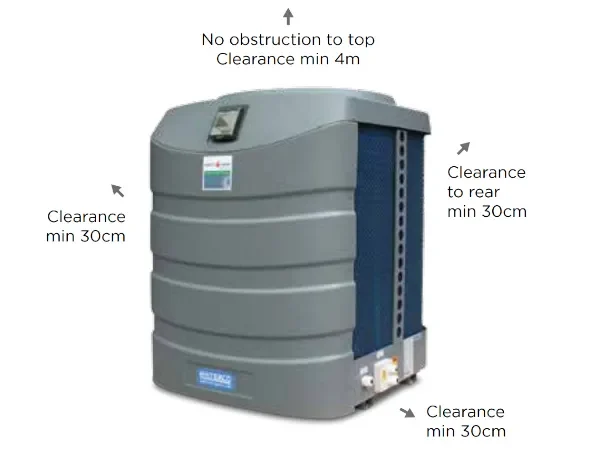
Clearance
Sizing Chart

| Sizing Chart to Heat Your Pool to 28°C | |||||
|---|---|---|---|---|---|
| Temperate Location * | Warm Location ** | ||||
| Up to 10 hrs / Day Run time | Up to 10 hrs / Day Run time | ||||
| Pool Size (m) | Litres | with Pool Cover | No Pool Cover | with Pool Cover | No Pool Cover |
| 3 × 6 | Up to 23000 | 12kW | 17kW | 12kW | 12kW |
| 3 × 7 | Up to 27000 | 12kW | 17kW | 12kW | 12kW |
| 4 × 7 | Up to 35000 | 17kW | 25kW | 12kW | 17kW |
| 4.5 × 8.5 | Up to 50000 | 21kW | 17kW × 2 | 12kW | 17kW |
| 5 × 10 | Up to 65000 | 25kW | 21kW × 2 | 12kW | 21kW |
| 5.5 × 11 | Up to 80000 | 17kW × 2 | 25kW × 2 | 17kW | 25kW |
| 6 × 12 | Up to 100000 | 21kW × 2 | 21kW × 3 | 21kW | 17kW × 2 |
Note: Size and performance are influenced by ambient temperature, humidity, use of a pool cover, night time temperature, pool location, wind factor, water features and if the unit is switched off over night. The recommended sizing in the table above is based on operating the unit up to 10 daytime hours with the pool subjected to normal suburban wind. No allowance has been made for the cooling effects of water features, negative edges or high wind areas. Therefore, any under sizing of the heater for your pool heating requirements is not the responsibility of Waterco.
*Temperature Location : Where minimum average daytime temperatures between September to April are not less than 18°C.
**Warm Location :- Where minimum average daytime temperatures between September to April are not less than 24°C.
Included In The Box
Waterco’s ElectroHeat Eco-V Inverter Swimming Pool Heat Pump
Proof of Purchase
1 Year Commercial Warranty
Contact Us